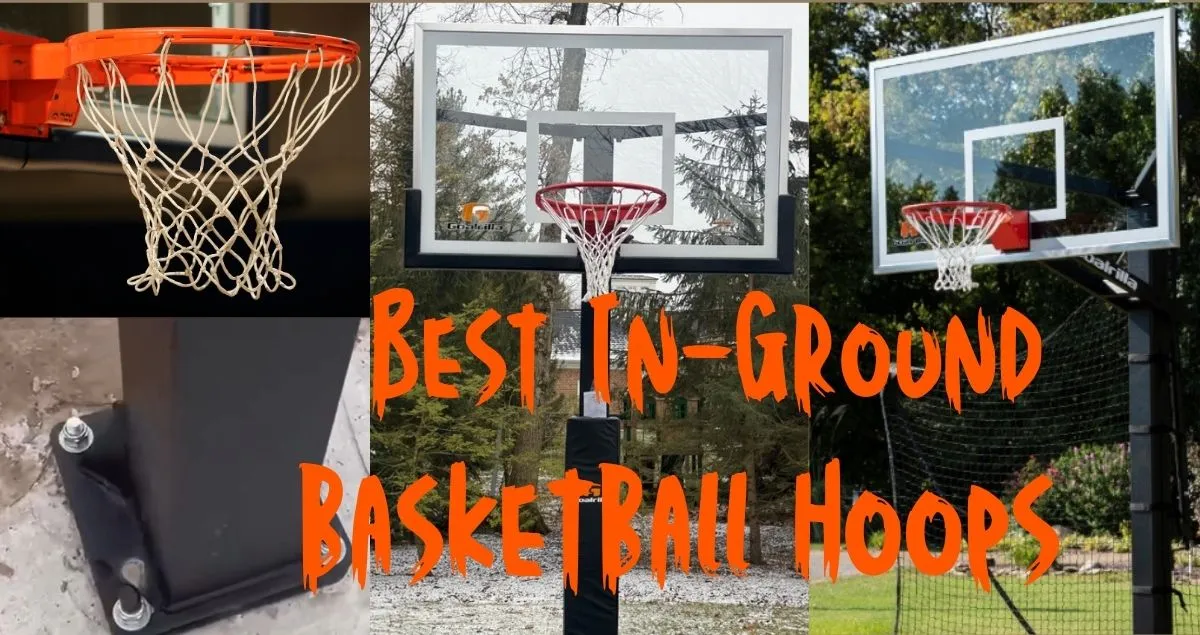
6 Best In-Ground Basketball Hoops of 2026 — Tested, Ranked, and Reviewed
When choosing the best inground basketball hoop, you must prioritize a one-piece 11-gauge steel pole, a tempered glass backboard, and a heavy-duty anchor bolt system for maximum stability. If you’re tired of the shaking, rattling, and rolling of a portable rim every time a ball hits the backboard, it’s time for a professional driveway upgrade. An inground system anchored deep in a solid concrete foundation provides a true arena bounce and handles the vibration of missed layups better than any plastic base. To ensure safety and pro-level performance, look for a system that balances structural integrity with a high-quality anchor kit that keeps the unit rock-solid during every dunk. While permanent installations offer the most stability, you can compare them against other top-rated setups in our comprehensive guide to the best outdoor basketball hoops currently on the market.
The best inground hoops stand out by offering superior build quality over flashy aesthetics, specifically featuring weather-resistant powder coating and pro-style breakaway rims to protect players’ wrists. A coach will tell you that the magic is in the details—like an easy-to-use height adjustment system so the kids can work on their form as they grow. Whether you have a massive dedicated backyard court or a standard three-car driveway, you need a setup that offers professional rebound quality and long-term durability. I’ve broken down the top-rated models on the market based on their structural grading and overall value to see which of these heavy hitters belongs in your starting lineup.
Let’s dive into the specific reviews and grading specs to see which of these heavy hitters belongs in your starting lineup.
For the person who wants the highest quality and has the budget
Check PriceFor the player who will not settle for anything less than a full regulation gymnasium experience in their own driveway
Check PriceFor serious player who wants 60-inch institutional-grade stability without the regulation-size footprint demand
Check PriceFor the family that wants durability without the professional arena price tag
Check PriceFor the players who wants Goalrilla’s lifetime glass warranty without paying CV series upgrade.
Check PriceHomeowner with a tight driveway who refuses to sacrifice tempered glass for a compact footprint.
Check PriceHow We Grade Every Rim: The Coach’s Checklist
Before you grab a shovel and start mixing concrete, you need to know exactly what separates a professional-grade setup from a flimsy driveway toy. When I’m scouting the best in-ground basketball hoops, I look past the fresh paint and focus on the structural “bones” of the system. A high-quality hoop is a long-term investment in your game, so we grade every model based on the same rigorous standards used for high school and college courts. We aren’t just looking for a rim that stands up. Rather, we are looking for a system that stays rock-solid during aggressive play and delivers a true arena feel.
To give you the most accurate rankings, our evaluation process focuses on these four non-negotiable pillars of performance:
- Vibration and Stability: The biggest difference between a pro hoop and a cheap one is the “shake” after a shot. We prioritize heavy-duty, one-piece steel poles and thick mounting brackets that absorb impact. If the backboard is still trembling five seconds after the ball hits the rim, it fails our stability test.
- Authentic Rebound Quality: To develop a real shooter’s touch, you need a consistent bounce. We look for tempered glass backboards, the same material used in the NBA. Because they offer superior energy transfer compared to acrylic or polycarbonate. A thick glass board ensures the ball pops off the surface exactly how you’d expect in a real game.
- Safety and Rim Hardware: A rim needs to give, but it also needs to protect. We grade the “breakaway” action of the goal, ensuring the compression springs can handle the load of a dunk without putting stress on the glass. We also check for essential safety features like pole padding and generous backboard overhang to keep players from running into the steel support.
- Installation and Longevity: An in-ground system is only as good as its anchor kit. We look for high-grade bolt-down designs that allow for precision leveling during the curing process. Our top picks also feature weather-resistant powder coating and zinc-plated hardware to ensure your hoop survives years of rain, snow, and heat without losing its structural integrity.
By measuring every hoop against these specific grading specs, we’ve narrowed down the field to the absolute best performers. Whether you’re building a championship-caliber backyard court or just want a reliable spot for the kids to practice their free throws, these next few picks represent the elite tier of driveway equipment.
Top-Rated In-Ground Basketball Hoop for Every Situation
Not every hoop on this list is built for the same player, the same driveway, or the same budget. What they share is this: all six are permanently anchored, all six use tempered glass or better-than-average backboard materials, and all six will outlast any portable system you can buy at the same price point. The reviews below cover the full picture ,construction, real-world performance, who each hoop is actually built for, and the one honest flag every buyer deserves to hear before the concrete goes in.
The Silverback SB54 is the hoop that hits the right number on every spec that matters — tempered glass backboard, pro-style breakaway rim, anchor bolt system for relocation, and DuPont powder-coat protection on a 4″ x 4″ steel pole, without crossing into the price territory that makes family budgets flinch. It plays like a gym hoop, installs like a permanent fixture, and moves with you if your address changes. For most homeowners who want serious performance without the Goalrilla price tag, the SB54 is the answer before they finish reading the question.
1. Silverback SB54 — Best Overall In-Ground Basketball Hoop for Serious Players
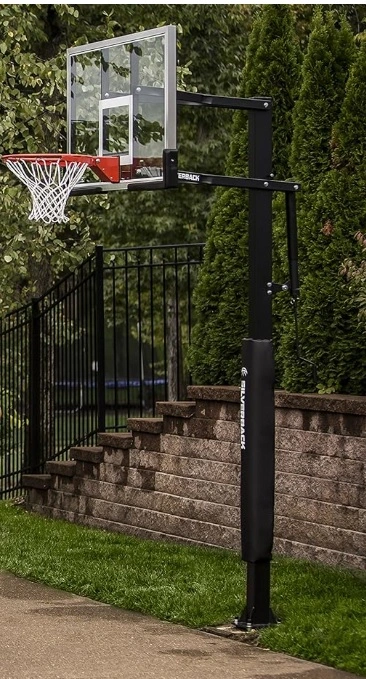
Specifications
- Backboard: 54″ x 33″ tempered glass, 3/16″ thick
- Pole: 4″ x 4″ powder-coated steel, DuPont finish, 2-piece with zinc-coated base
- Overhang: 2 feet
- Height Adjustment: All-steel crank actuator, 7.5′ to 10′
- Mounting: Anchor bolt system — concrete-set but relocatable
- Rim: Pro-style breakaway, flexes under pressure
- Includes: Backboard pad
- Warranty: 5-year limited
Here’s the honest positioning: the SB54 is Silverback’s top-of-line residential system, and it earns that label. This isn’t the budget Silverback. It’s the one they built to answer the question — what if you want glass, breakaway, and bolt-down relocatability without paying Goalrilla prices?
The answer is pretty good.
The backboard is tempered glass on a powder-coated steel pole, with a bolt-down anchor system that lets you unbolt and relocate the entire setup if you move. That combination of glass with genuine relocatability is rare at this price tier. Most hoops at this level give you one or the other. The SB54 gives you both, which is why it earns attention.
The pole is a 4-inch square section , two-piece construction. It’s not the monolithic one-piece 5×5 you get with the GS54, and you’ll feel that delta if you play aggressively. But for the overwhelming majority of residential players — including teenagers playing real ball — the 4-inch square tube is adequate. It limits vibration better than round poles and holds the backboard steady under normal play conditions.
The breakaway rim flexes under pressure and springs back to position — same principle you see on institutional hoops. That rim protects the backboard mounting hardware over time, which matters more than people realize. Cheap fixed rims transfer every dunk load directly into the backboard arms. This one absorbs it. The included backboard pad is a nice touch — most competitors charge extra or skip it entirely.
Height adjusts from 7.5 to 10 feet via crank actuator , covering everything from youth development to full regulation. The mechanism is clean and doesn’t bind.
Backed by a 5-year limited warranty. Not a lifetime warranty, but respectable for the price.
Who it’s for: Players who want genuine glass-backboard performance and the flexibility of bolt-down installation, without crossing into four-figure territory.
Bottom line: The SB54 does what mid-tier hoops rarely do — it doesn’t force you to choose between glass and relocatability. If you’re shopping between $800 and $1,000 and want a hoop that plays like a gym hoop, this belongs on your shortlist.
Coach’s Rating: 4.7 / 5 : Gym-quality glass and a relocatable anchor at a price that does not require a second mortgage.
Community Rating: 4.6 / 5 : Based on 1496 verified buyer reviews
- Pack-up-and-move anchor bolt system — rare at this level
- Gymnasium-grade tempered glass rebound
- DuPont powder coat fights rust at the base where it matters most
- Pro-style breakaway rim included out of the box
- All-steel crank — smooth adjustment every time
- Glass thickness at 3/16″ falls short of premium Goalrilla glass
- 2-foot overhang may feel a touch tight for post play
- 5-year warranty is respectable but not a lifetime pledge
- Pole pad is not included — worth adding for younger players
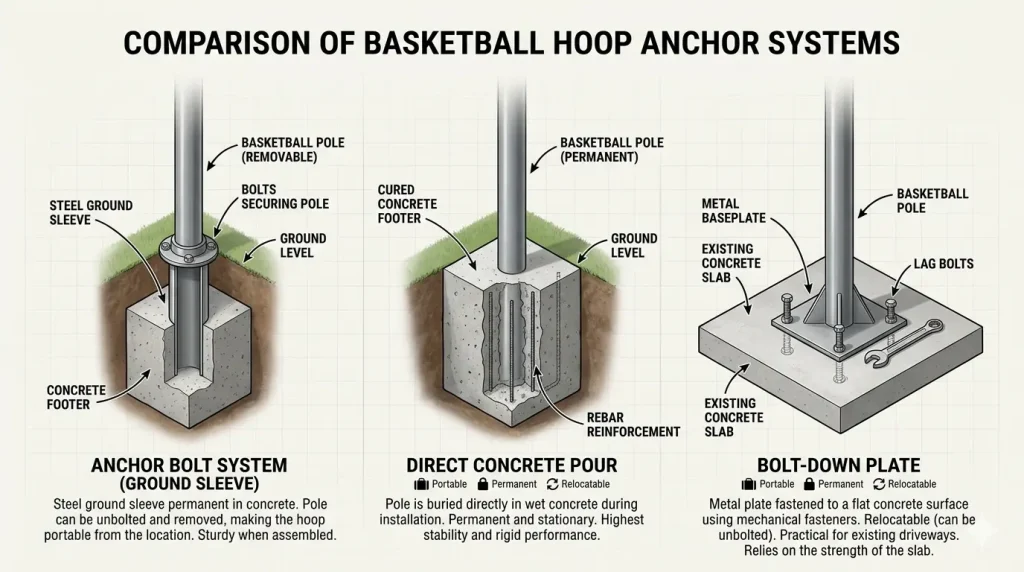
Coach’s Corner: Anchor Systems Explained
You just read about the SB54’s anchor bolt system and why it lets you take the hoop with you when you move. That detail is worth pausing on because anchor type is the spec nobody talks about in the store and the first thing you wish you had asked about three years later.
There are three anchor systems in the residential market:
Anchor Bolt System : A steel sleeve goes into the concrete and cures in place. The pole bolts down onto the sleeve. During play it performs identically to a direct pour — the concrete still carries the load. The difference is portability. When you move, you unbolt the pole, buy a new anchor kit for the new address, and the hoop travels with you. This is what the Silverback SB54, Goalrilla FT72, Goalrilla GS54, and Ironclad Game Changer all use. For a product in the $800 to $2,000 range, this is the only anchor system that makes financial sense.
Direct Concrete Pour : The pole goes straight into a concrete-filled hole. Maximum stability, zero relocation options. Once that concrete cures around the pole, you are leaving it behind when you sell the house or grinding concrete for an afternoon. Shows up on older designs and some budget models. Fine if you are certain you will never move. A gamble if you are not.
Bolt-Down Plate : An anchor plate fastens to an existing concrete slab using lag bolts rather than being embedded in a deep pour. Faster to install, easier to relocate, but holding strength depends entirely on the quality of the concrete slab underneath. The Lifetime 54″ Crank Adjust uses this system — which is part of why it earns the tight driveway category. Practical where a full concrete pour is not possible.
The bottom line on anchors: if you are spending serious money on a hoop and there is any chance you will move in the next decade, the anchor bolt system is the only responsible choice.
Many homeowners find that in-ground systems are the most professional choice among the best basketball hoops for driveway use, provided you have the space for a fixed pole.
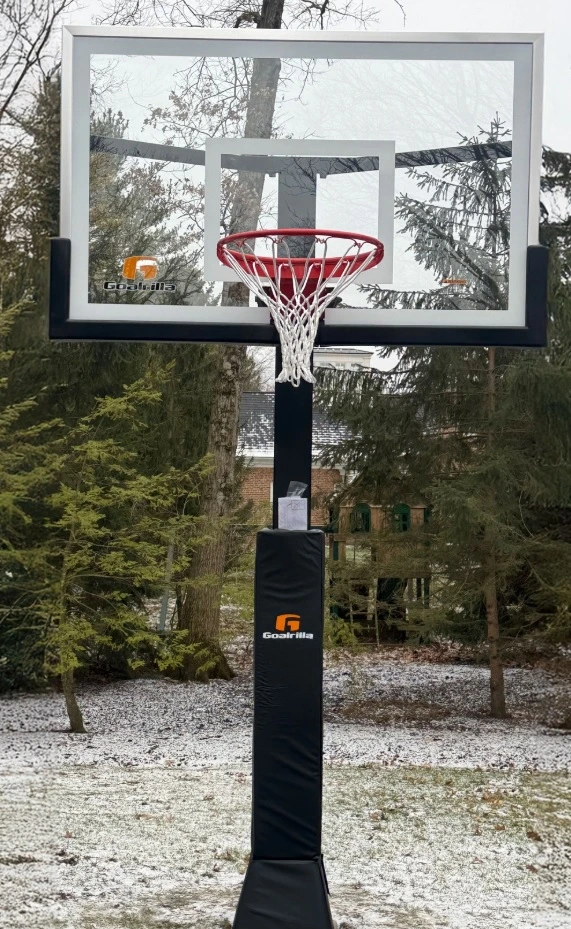
2. Goalrilla FT72 — The Pro-Style Choice 72″ Glass Inground Hoop
Our Verdict
The Goalrilla FT72 is not a typical backyard hoop — it’s a true regulation system in a residential location. With its 72×42″ tempered glass backboard, massive 6×6″ steel pole, and professional-grade bolt-down anchoring, this hoop delivers a real gym-like experience at home. It justifies its price with unmatched stability, rebound, and durability for serious players who refuse to compromise on performance.
Specifications
- Backboard: 72″ x 42″ tempered glass (ClearView), 3/8″ thick
- Pole: 6″ x 6″ one-piece powder-coated steel
- Overhang: Up to 4 feet
- Height Adjustment: Crank actuator, 7.5′ to 10′
- Mounting: Concrete-cured anchor, bolt-down relocatable
- Technology: Three-Point Technology — 1-piece pole + dual extension arms + Triple-Joint connection
- Rim: Heavy-duty breakaway
- Warranty: Lifetime limited
This is not a residential hoop. It is a regulation hoop installed in a residential location. That distinction is important before you read further.
Key Qualities & Hands-On Experience
- Court Experience: Regulation-size backboard recalibrates your entire game — mid-range shots, passing lanes, and angles feel authentic, just like a professional court.
- Stability & Anchoring: One-piece 6×6″ steel pole anchored into concrete ensures rock-solid stability. No wobble or tipping during intense play.
- Rim Performance: Professional-grade breakaway rim absorbs repeated dunks with full vertical force — built to last.
- Durability: Tempered glass and powder-coated steel handle long-term outdoor use and harsh weather without degradation.
- Installation: Professional-grade setup required: concrete pad, precise alignment, full-day labor. Permanent residential court.
- Adjustability: Smooth crank actuator moves height from 7.5′ to 10′ for all skill levels.
- Technology: Three-Point Technology (one-piece pole + dual extension arms + Triple-Joint connection) provides solid, unyielding support.
- Who It’s For: Serious players, competitive trainers, former college athletes, or anyone seeking a true gym-level experience at home.
- Value: $2,000–$2,500 reflects professional-grade materials and installation.
The Hands-On Verdict:
Installation is a full-day project and requires concrete preparation and heavy lifting, but the payoff is immense. Once anchored, the FT72 feels like a real court. Every shot, pass, and dunk is authentic, with predictable rebound and rock-solid stability. The breakaway rim gives satisfying spring-action, and the tempered glass backboard keeps your game realistic. This hoop isn’t just a purchase — it’s a residential training upgrade.
Coach’s Rating: 4.8 / 5 — Closest a residential hoop gets to a regulation gymnasium.
Community Rating: 4.7 / 5 — 216 verified buyers confirm performance and durability.
Key Takeaway:
The Goalrilla FT72 is the ultimate investment for serious players. It delivers regulation-sized play, unmatched stability, and professional-grade rebound, all in a permanent residential setup. Perfect for home courts where performance matters.
While these heavy-duty systems are built for adults, if you are strictly looking for a starter setup for toddlers, you may want to check out our top picks for basketball hoops for kids and children.
- Full regulation 72″ x 42″ glass — same size as a gym
- Three-Point Technology makes this pole nearly shake-free
- 6″ x 6″ one-piece pole — built like a fire hydrant
- Lifetime warranty covers the glass — that’s rare
- Relocatable anchor system — takes it with you if you move
- 72″ backboard demands a wide driveway — measure before you buy
- Installation is a serious concrete project — not a weekend solo job
- Price sits at the higher end for residential buyers
- Pole pad sold separately for this model
Coach’s Corner: Backboard Materials — What the Spec Sheet Does Not Tell You
The FT72 uses 3/8-inch ClearView tempered glass — the thickest backboard on this list. That number means something, but only if you understand what separates the three backboard materials competing for your attention.
| Material | Rebound Quality | Durability | Weather Resistance | Best For |
|---|---|---|---|---|
| Tempered Glass | True, consistent — identical to a gym backboard | Can shatter on extreme direct impact — one-time replacement warranty on most brands | Excellent with aluminum frame — UV and rain resistant | Serious players, teens, adults, anyone who plays competitively |
| Acrylic | Good — noticeably better than polycarbonate, slightly softer than glass | Scratches over time, yellows in UV exposure after 3 to 5 years | Moderate — UV degradation is the main long-term issue | Recreational families, players under 12, budget-conscious buyers |
| Polycarbonate | Soft and inconsistent — ball response varies across the board surface | Nearly unbreakable — takes abuse without shattering | Good — resists impact and weather but yellows with age | Young children, first hoops, commercial settings where vandalism is a concern |
Three things that table does not capture:
First, glass thickness is not uniform across brands. The IGL In-Ground 52″ uses a shatterproof non-glass backboard. The Silverback SB54 uses 3/16-inch glass. The Goalrilla GS54 and FT72 both use 3/8-inch glass. The Ironclad Game Changer uses 5/16-inch glass. Thicker glass means a livelier, more consistent rebound — experienced players feel the difference immediately.
Second, frame construction matters as much as material. A tempered glass board in a flimsy steel frame will flex and deaden the rebound almost as much as acrylic. The Goalrilla FT72’s welded board arms and aluminum frame keep the glass rigid under impact. That rigidity is what produces the sharp, predictable response serious players expect.
Third, most tempered glass warranties include a one-time backboard replacement clause for accidental breakage. The Goalrilla lifetime warranty covers the glass outright. Read the warranty before you buy — a glass backboard without breakage coverage is a financial risk on a high-traffic family driveway.
The short version: if players in your household are serious about the game, tempered glass is not an upgrade — it is a requirement. Everything else is a compromise you will feel on every bank shot.
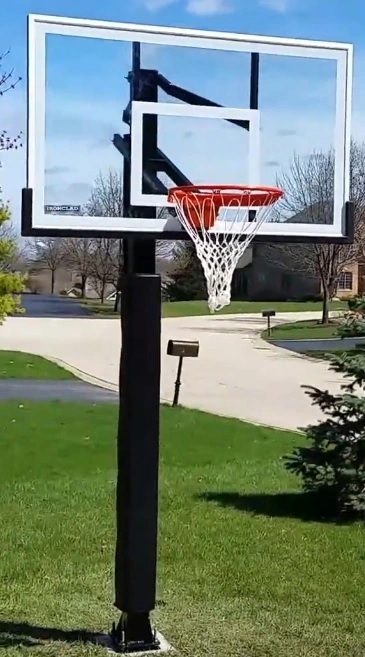
3. Ironclad Game Changer GC55-LG — Most Stable 60″ in-ground Basketball Hoop
Specifications
Specifications Rating: ⭐⭐⭐⭐⭐
- Backboard: 60″ x 36″ tempered glass, 5/16″ thick
- Pole: 5″ x 5″ one-piece, 12-gauge steel, powder-coated black
- Overhang: 30″ post-to-backboard offset
- Height Adjustment: All-steel rear-crank actuator, 7.5′ to 10′
- Mounting: Bolt-down anchor, relocatable
- Frame: Aluminum trim, zinc-coated hardware for corrosion resistance
- Rim: Institutional-grade NBA-style breakaway
- Includes: Post pad, backboard pad, composite leather basketball
- Warranty: Lifetime (includes dunking on GC models per warranty terms)
Product Description
Sixty inches of tempered glass on a one-piece 5-inch post is not a backyard hoop. It’s a backyard gym. That’s the promise of the Ironclad Game Changer, and it delivers more than most hoops at this price point have any right to.
The 60×36-inch glass backboard is the headline feature and it earns its billing. At 5/16-inch thickness it sits between entry-level glass and the competition-grade 1/2-inch you find in high school gyms, but the rebound response is genuine. Ball bounce off the backboard is true and authentic , the kind that rewards a proper bank shot instead of punishing it. For a driveway hoop, that’s the whole game.
The post is where Ironclad separates itself from the crowd at this price. The 12-gauge 5×5-inch one-piece post is thicker and far superior in strength to competitors’ thinner two-piece designs. No joint halfway up the shaft, no flex under a hard drive, no shimmy when someone hangs on the rim after a layup. Professional installers who encounter this system for the first time are consistently impressed with the durability and ease of installation relative to cost. That’s not marketing, that’s a field observation from someone who sets these up for a living.
The 30-inch offset between the backboard and the post is a detail most buyers overlook until they’re playing under the rim. More clearance means fewer collisions with the pole on drives and post moves, and it opens up the playing space underneath in a way that tighter overhang systems simply don’t.
Ironclad’s founders are credited with inventing the spring-assist mechanism that makes basketball goals crank upward as easily as downward, an innovation since imitated by most of the industry. That heritage shows in the actuator on the Game Changer. It moves smoothly in both directions and the rim height indicator removes any guesswork when you’re adjusting for younger players.
The bolt-down installation means this hoop is permanent when you want it to be and removable when you need it to be. The lifetime warranty covers basketball-related damage including dunking, and includes a one-time unconditional glass replacement if the backboard ever breaks. That’s a real warranty, not a fine-print warranty.
One real customer summed it up well after installation: crystal clear instructions, husband assembled most of it solo, incredibly sturdy, and the vendor proactively helped resolve a freight delivery delay. When the product and the service both hold up, you’re dealing with a brand that built something they stand behind.
Who it’s for: Serious recreational players and families who want a genuine 60-inch glass backboard experience without paying regulation-size prices. If you have the driveway space and you’re done compromising on backboard size, this is where you land.
Bottom line: The Game Changer lives up to its name. One-piece post, real glass, lifetime warranty that actually covers dunking. At this price point with this spec sheet, it’s the most honest value in the 60-inch in-ground category.
Coach’s Rating: 4.6/ 5 : Built like it was designed for a school gym, priced like it was not. Though have structural integrity of a 12-gauge one-piece steel post.
Community Rating: 4.8/ 5 : Based on 81 verified buyer reviews
- One-piece 12-gauge pole — thicker than most competitors at this price
- Institutional-grade breakaway rim used in schools and colleges
- Post pad and backboard pad included — ready to play safely
- Lifetime warranty covers dunking — no asterisks on that
- Made in the USA
- Glass at 5/16″ is thinner than premium models — rebound is still solid
- 30″ overhang is workable but not ideal for serious post game
- Brand recognition is lower — harder to find at local retailers
- Crank handle sits low — some taller adults may find it slightly awkward
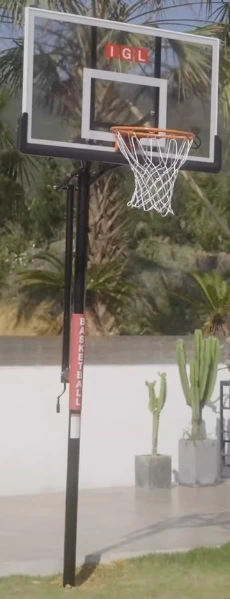
4. IGL TIR52 — Leading Cheap In-Ground Basketball Hoop Under $300
Specifications
- Backboard: 52″ x 32″ shatterproof impact-resistant backboard
- Pole: Square steel pole, in-ground anchor system
- Height Adjustment: Hand-crank, 7.5′ to 10′
- Mounting: Prefabricated in-ground anchor kit with rebar
- Rim: 18″ steel breakaway
- Weather Resistance: Powder-coated finish, windproof and waterproof tested
- Support: US-based team, 24-hour response, step-by-step visual manual
- Warranty: Limited (1 year)
IGL is not a name you’ll find in a high school gym. It’s not sponsoring AAU tournaments. It’s a small, Amazon-native brand that showed up, built an in-ground system at a price point the established players won’t touch, and apparently answers its support emails. In this category, that last part is rarer than it should be.
The specs tell you what you’re buying.
The 52-inch shatterproof backboard pairs with a hand-crank height system that adjusts from 7.5 to 10 feet without tools — full range, clean operation. The backboard is not tempered glass. It’s a shatterproof composite, which is the honest trade-off at this price. Don’t expect glass rebound response. What you get is a surface that won’t crack from a wayward elbow or a bad freeze-thaw cycle, and real customers back that up: one reviewer noted the board cracked during an ice storm and IGL replaced it under warranty, no questions asked.
The installation kit comes prefabricated with rebar accessories, and IGL claims it’s 50% faster to set up than standard in-ground systems . Based on customer feedback, that claim holds up — multiple buyers report clean, straightforward installation with the included visual manual. The anchor goes into concrete, same as any real in-ground system. Once it’s in, it’s in. The in-ground mount is sturdy and the 52-inch backboard provides solid rebounding for recreational and developmental play.
The pro-style breakaway rim is a legitimate feature at this price. It flexes under load and returns to position — which protects both the backboard hardware and the player on a hard drive to the rim.
The US-based support team resolves installation and after-sales issues within 24 hours , and that shows up consistently across verified reviews. For a newer brand, that responsiveness is their real differentiator.
Who it’s for: Budget-conscious families, younger players getting serious about the game, and anyone who wants a real in-ground installation without committing to a four-figure system.
Bottom line: IGL punches above its price class. A Best Budget In-Ground hoop Under $300 .If below 500$ is your ceiling and you want cement-anchored stability, this is the honest answer.
Coach’s Rating: 4.5/ 5: Delivers the two things a budget buyer actually needs. 1. permanent anchor 2. crank adjustment, without dressing itself up as something it is not.
Community Rating: 4.5 / 5: Based on 60 verified buyer reviews
- Prefab anchor kit cuts installation time significantly
- Hand-crank height adjustment at a price point where most skip it
- US-based support team with 24-hour turnaround
- Windproof and waterproof tested for outdoor durability
- Shatterproof backboard — functional, but not the glass feel serious players prefer
- Warranty terms vary by model — worth confirming before purchase
- Lighter construction reflects the budget price — not built for heavy dunking
- Brand track record is shorter than established names in this space
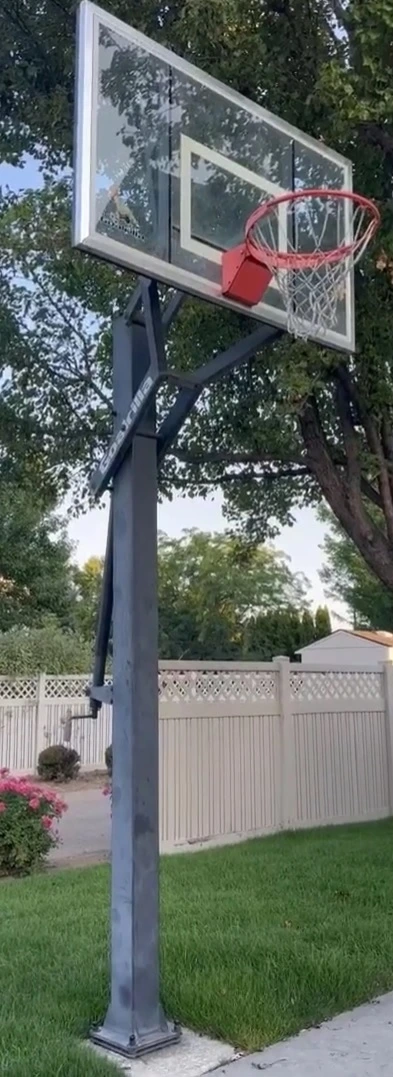
5. Goalrilla GS54 Review: The Best Compact 54-Inch In-Ground Hoop
Specifications
- Backboard: 54″ x 34″ ClearView tempered glass, 3/8″ thick
- Pole: 5″ x 5″ one-piece, 14-gauge powder-coated steel
- Overhang: 2.5 feet
- Height Adjustment: Crank actuator, 7.5′ to 10′
- Mounting: Concrete anchor, bolt-down relocatable
- Board Arms: Welded ultra-wide span arms, welded steel board frame
- Rim: Medium-weight flex rim
- Warranty: Lifetime limited (includes glass)
Product Description
If you’re serious about having a real hoop in your driveway, this is where the conversation starts and, for most people, ends.
Backboard: The GS54’s 54×34-inch backboard is cut from 3/8-inch tempered glass, the same spec you’ll find in high school and collegiate facilities. You’re not playing off a polycarbonate trampoline. Shots respond the way shots are supposed to respond. Bank it off the right corner, it comes back true. That matters whether you’re a 14-year-old learning geometry or a 40-year-old trying to keep your mid-range honest.
The pole is a one-piece 5×5-inch steel column. No two-piece wobble, no joint flex midway up the shaft. When you throw down or a kid hangs on the rim after a layup, the system doesn’t shimmy. That rigidity is the difference between a hoop that trains you and a hoop that teaches you to adjust for its flaws.
Installation is bolt-down into a concrete anchor. It’s as permanent as you want it to be, and relocatable if you ever move. The height adjustment runs from 7.5 to 10 feet via crank actuator, smooth, no tools, no fighting the mechanism while three kids wait behind you.
The limited lifetime warranty covers the glass. Most competitors quietly exclude the backboard. Goalrilla doesn’t.
Who it’s for: Anyone who wants one hoop, wants it done right, and doesn’t want to think about it again for 15 years.
Bottom line: The GS54 is the standard — every other 54-inch hoop on this list is either trying to match it or explaining why it costs less.
Coach’s Rating: 4.6 / 5 : Goalrilla’s entry point still outclasses most competitors at the finish line.
Community Rating: 4.5 / 5 : Based on 159 verified buyer reviews
- 3/8″ ClearView glass — thicker than Silverback, cleaner rebound
- Welded ultra-wide span arms — zero board wobble during play
- Lifetime warranty includes the glass — industry-leading coverage
- One-piece 5″ x 5″ pole — no flex, no excuses
- Anchor system lets you take it to your next home
- Padding not included — budget for pole and backboard pad separately
- 2.5-foot overhang is on the shorter side for aggressive under-the-basket play
- Entry-level Goalrilla — serious dunkers may want to step up to the CV series
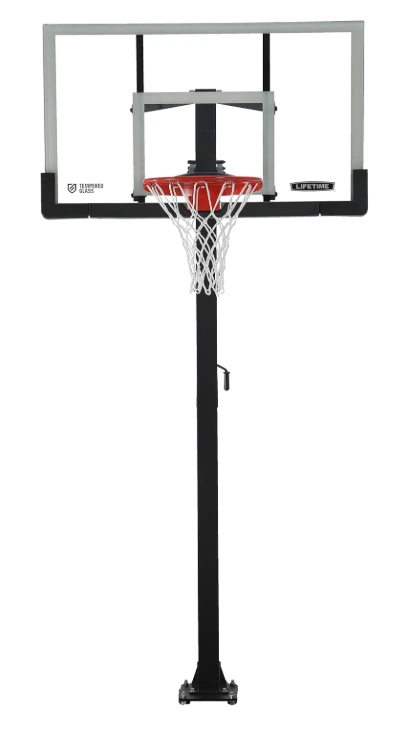
6. Lifetime 54″ Crank Adjust — Ideal In-Ground Basketball Hoop for Tight Driveways
Specifications
- Backboard: 54″ tempered glass, 3/8″ thick, fade-resistant graphics
- Pole: 4″ square 2-piece bolt-down, powder-coated steel
- Overhang: 24″ to 28.5″ (compact footprint)
- Height Adjustment: Crank Adjust mechanism, infinite increments 7.5′ to 10′
- Mounting: Bolt-down cement anchor kit included
- Rim: Slam-It Ultra, 18″ with wrap-around steel brace
- Net: Heavy-duty all-weather nylon
- Warranty: 5-year limited
Product Description
Most hoops assume you have room. This one was designed by someone who measured first.
The Lifetime 54″ Crank Adjust is the answer to a specific problem: you want a permanent, quality in-ground hoop, but your driveway, lot line, or garage placement limits your overhang options. Lifetime’s offset arm design on this model positions the backboard with less forward projection than most 54-inch systems, giving you functional court space in a footprint that would force you to compromise with other hoops.
The backboard is shatter-resistant fusion material — not tempered glass, but a step above standard acrylic. It’s impact-resistant and holds up to outdoor elements better than acrylic in freeze-thaw climates. Rebound response is acceptable for recreational play. Won’t satisfy a glass snob, but it’s not trying to.
The bolt-down anchor system is genuinely one of Lifetime’s better design decisions. The bolt-down configuration means installation is clean, the hoop can be removed if you sell the house (or relocate), and the anchor profile is lower than many competitive systems.
Height adjustment via crank runs 7.5–10 feet smoothly. This is a Lifetime strength — their height adjustment mechanisms are consistently well-executed across their product line.
The pole is 3.5-inch round steel. It’s not a premium gauge, but it’s appropriately sized for the backboard it’s supporting and the use case it’s designed for.
At the $500–$700 price range, you’re getting a real in-ground hoop in a space-efficient package. That’s the sale.
Who it’s for: Homeowners with narrow driveways, corner lots, or proximity to structures that limit standard overhang clearance.
Bottom line: The right hoop for the right driveway. If space is your problem, this solves it.
Coach’s Rating: 4.7 / 5 : The right answer for the wrong driveway — compact, practical, and honest about its limits.
Community Rating: 4.5 / 5: Based on 190 verified buyer reviews
- Shortest footprint on this list — fits where others don’t
- Infinite height increments — no awkward locked positions
- Slam-It Ultra rim with wrap-around steel brace — handles punishment
- Cement anchor kit included — no extra purchases to get started
- Widely available — easy to find parts and support
- 4″ pole is the slimmest on this list — adequate, not imposing
- 2-piece pole design introduces a joint that heavier players will notice over time
- 5-year warranty is the shortest coverage here
- Backboard graphics fade — cosmetic concern more than a performance one
Still Unsure? Key Factors to Consider Before Digging
Even after looking at the top picks, I know that picking a permanent fixture for your driveway can feel like a high-stakes play. You only want to mix the concrete once, so getting the technical specs right before the shovel hits the dirt is non-negotiable. Beyond the brand name, two critical factors—backboard dimensions and player safety—will determine whether your court feels like a professional arena or a cramped playground.
Choosing the Right Backboard Size
Most buyers fixate on the number — 54 inches, 60 inches, 72 inches — without connecting it to the space they actually have. A 72-inch backboard on a narrow driveway does not just look wrong, it plays wrong. You end up with players crowding the lane, no room for a proper step-back, and corner threes that end in someone’s flower bed.
The rule of thumb coaches use is simple: measure your playing surface first, then choose your backboard. A 54-inch board needs a minimum driveway width of 16 feet for comfortable play. A 60-inch board asks for 18 feet. A full regulation 72-inch board — like the Goalrilla FT72 — needs at minimum 20 feet of width to breathe properly, and that is before you account for the overhang distance from the pole to the backboard.
Here is how backboard size maps to driveway width in practical terms:
| Backboard Size | Minimum Driveway Width | Ideal Playing Surface | Best Pick From This List |
|---|---|---|---|
| 52″ | 14 ft | Beginner and youth play | IGL In-Ground 52″ |
| 54″ | 16 ft | Family and recreational play | Silverback SB54 / Goalrilla GS54 / Lifetime 54″ |
| 60″ | 18 ft | Competitive recreational play | Ironclad Game Changer GC55-LG |
| 72″ | 20 ft | Regulation and serious training | Goalrilla FT72 |
One more factor that does not show up in spec sheets: overhang. Overhang is the horizontal distance from the pole to the center of the backboard. A 2-foot overhang means the pole sits 2 feet behind the baseline. A 4-foot overhang gives players more room to drive the lane without running into the pole. If your driveway is short front-to-back rather than side-to-side, overhang matters as much as backboard width. The Goalrilla FT72 offers up to 4 feet of overhang. The Lifetime sits at 24 inches — compact, but it shows during aggressive drives.
Pole Gauge: The Number Most Buyers Ignore
Steel gauge is one of those specs that reads backwards to anyone who has not encountered it before. A lower number means thicker, stronger steel. A 12-gauge pole is more substantial than a 14-gauge pole of the same outer dimensions. Most buyers see a bigger number and assume it means more — in this case it means less, and the difference matters when a 200-pound player is hanging on the rim.
For families with kids under 14 playing recreational ball, a 14-gauge 4″ x 4″ pole is adequate. The moment dunking enters the picture — even aggressive layoffs the rim — you want to be at 12-gauge minimum with a 5″ x 5″ cross-section. The Ironclad Game Changer GC55-LG uses exactly that combination, which is why its warranty covers dunking without the fine print most brands hide behind. The Goalrilla FT72 takes it further with a 6″ x 6″ one-piece pole that is in a different category entirely. One-piece construction matters as much as gauge — a two-piece pole has a joint, and every joint is a potential flex point under repeated dynamic load.
Height Adjustment: Which Mechanism Fits Your Household
There are three height adjustment mechanisms in the residential market and they are not interchangeable in terms of daily usability.
The crank actuator is the most common on this list. You turn a handle, the backboard moves smoothly up or down, and it locks at the height you set. The Silverback SB54, Goalrilla FT72, Goalrilla GS54, and Ironclad Game Changer all use this system. It is reliable, requires no tools, and a younger player can operate it independently once they are tall enough to reach the handle.
The Lifetime Crank Adjust uses a similar principle with infinite height increments rather than preset stops. This means you can land at any height between 7.5 and 10 feet rather than jumping between fixed positions — genuinely useful in households where a 9-year-old and a 16-year-old share the same hoop.
The pump adjust, found on some Lifetime models not on this list, uses a triggerless lever rather than a turning handle. Faster to operate but slightly less precise for players who care about exact rim height during training.
If your household has players ranging from elementary school age to adult, the infinite crank adjust is the most practical daily mechanism. If everyone playing is above 5 feet tall and plays at or near regulation height, preset stops on a standard crank actuator are perfectly sufficient.
Installation: What You Are Actually Committing To
In-ground installation is not complicated but it is physical, it requires patience, and skipping any step costs you stability you will never fully recover. Here is what the job actually involves:
You are digging a hole 48 inches deep and 16 inches wide. That is a post-hole digger job at minimum, a rented power auger if your soil is compacted or rocky. The hole fills completely with concrete — not a partial pour, not a bag of gravel at the bottom. Full concrete, fully cured.
Cure time is 72 hours minimum at temperatures above 50°F. Below that temperature, give it 96 hours. The concrete will feel set long before it reaches working strength. Bolting down and playing at the 24-hour mark is the single most common installation mistake on every basketball hoop forum on the internet. The damage shows up months later as micro-movement in the anchor that gradually worsens.
Before you dig the hole for your new system, make sure you understand the official regulation height of a basketball hoop to ensure your court is set up for professional-level practice.
Here is everything you need on installation day:
- Post-hole digger or power auger (rental)
- Concrete mix — 2 to 3 bags of 80lb fast-setting concrete for most residential anchors
- Level — essential for getting the pole perfectly vertical before the concrete sets
- Tape measure
- Wrench set for anchor bolt hardware
- Two people minimum — one to hold the anchor plumb, one to pour and check level
- Temporary bracing or stakes to hold the anchor in position during cure
The anchor goes in first, concrete follows, cure time is non-negotiable, pole bolts on after. That sequence does not change regardless of the brand or the model.
Prioritizing Player Safety and The Buffer Zone
Every coach who has run a driveway practice knows the moment a player drives hard to the basket and pulls up because the pole is right there. That hesitation is not caution — it is a learned flinch from a hoop installed too close to the playing surface. It affects shot confidence, it affects drives, and over time it affects how aggressively a player is willing to attack the basket at all. Bad equipment creates bad habits. This is one of them.
The buffer zone is the clear space between the pole and the nearest hard surface — the garage door, a fence, a retaining wall, a parked car. The minimum acceptable buffer is 3 feet behind the baseline where the pole sits. The recommended buffer for serious play is 6 feet. This is not padding advice — it is spatial advice about where you position the entire system before the concrete goes in.
Overhang selection plays directly into this. A 4-foot overhang like the Goalrilla FT72 pushes the pole further from the baseline, which means more buffer space between the pole and any player driving the lane. A 2-foot overhang like the Silverback SB54 puts the pole closer to the action. Neither is wrong — but on a shorter driveway where buffer space is limited, a longer overhang is always the safer configuration.
Padding is the second layer of this conversation. A pole pad does not prevent contact but it converts a hard steel impact into something survivable during an off-balance drive or a defensive scramble. The Ironclad Game Changer includes pole and backboard padding as standard. The Goalrilla and Silverback models either include backboard padding alone or require it as an add-on purchase. Budget for it regardless. A pole pad costs $30 to $60 and it earns its keep the first time a 13-year-old misses a step on a fast break.
Coach’s Note: Before you finalize your spot, always check your local HOA regulations and “Call Before You Dig” (811) to locate underground utilities. A rock-solid anchor kit is useless if it interferes with your home’s main lines!
In-Ground vs Portable: Which One Actually Fits Your Life
Before you commit to a concrete pour, run through this honestly. Six criteria, no fluff.
| Criteria | In-Ground | Portable |
|---|---|---|
| Stability | Concrete-anchored — zero sway under dunks | Base-weighted — wobbles increase with age and heavy play |
| Play Quality | Matches gym feel — glass rebound, solid rim response | Acceptable for casual play — backboard flex reduces rebound accuracy |
| Installation | 48″ deep hole, concrete cure, 2-person minimum, half a day | 30 to 60 minutes, no tools, one person can manage |
| Relocation | Bolt-down systems move with you — direct pours do not | Rolls to any spot, indoors or out, no commitment |
| Cost | $500 to $2,500 for the system — add $200 to $400 for professional installation | $150 to $800 — no installation cost |
| Lifespan | 15 to 25 years with proper anchor and maintenance | 5 to 10 years — base degradation and UV damage accelerate wear |
Who should go in-ground: Homeowners with a driveway or yard, players who dunk or play seriously, families who want a hoop that outlasts childhood, anyone planning to stay in the house more than three years.
Who should stay portable: Renters, families with kids under 10, anyone with a HOA restriction on permanent structures, buyers who need to move the hoop seasonally.
Still you aren’t ready for a permanent concrete installation, a high-quality outdoor portable basketball hoop might be a better fit for your flexibility needs.
Frequently Asked Questions
The Lifetime 54″ Crank Adjust is the strongest choice for tight spaces. Its 24-inch pole-to-backboard offset is the most compact on this list, and the bolt-down anchor system works on an existing concrete pad without requiring a full excavation. If you want to step up to tempered glass without sacrificing footprint, the Silverback SB54 with its 2-foot overhang is the next closest option.
Since these systems are exposed to the elements year-round, following a regular basketball hoop maintenance routine is essential to prevent rust and keep the height-adjustment mechanism smooth.
The standard recommendation across all major brands is a minimum of 48 inches deep with a hole diameter of at least 16 inches. Fill the hole completely with concrete and allow a full 72-hour cure before attaching the pole. Cutting cure time short is the single most common installation mistake — the concrete may feel set at 24 hours but it has not reached working strength yet. In colder climates, extend cure time to 96 hours.
For anyone playing seriously, yes — without argument. Tempered glass gives you a true, consistent rebound that acrylic and polycarbonate simply cannot match. The ball responds the same way every time regardless of where it hits the board, which is exactly what you need when you are working on bank shots and off-glass finishes. Acrylic is acceptable for younger kids and casual play. Polycarbonate is durable but the rebound feels dead compared to glass — experienced players notice it immediately.
It depends on the anchor system. Hoops using an anchor bolt system — including the Silverback SB54, Goalrilla FT72, Goalrilla GS54, and Ironclad Game Changer — can be unbolted from the in-ground sleeve and reinstalled at a new address. You purchase a new anchor kit for the new location and bolt the existing pole back down. Direct concrete pour systems, where the pole is set directly into concrete, cannot be relocated without significant demolition work. Always confirm the anchor type before buying if relocation is a possibility.
A minimum of 4″ x 4″ pole is the entry point for dunking, but serious players should look at 5″ x 5″ or larger. Pole gauge matters as much as size — lower gauge numbers mean thicker steel, so a 12-gauge pole is stronger than a 14-gauge pole of the same dimensions. The Ironclad Game Changer uses a 12-gauge 5″ x 5″ one-piece pole, which is one of the most durable constructions in the residential market. The Goalrilla FT72 steps up to a 6″ x 6″ pole for players who are playing at near-competition intensity.
Concrete reaches initial set in 24 to 48 hours — firm enough to stand on but not strong enough to support dynamic loads like dunking and aggressive play. Full working strength for basketball hoop anchors requires a minimum of 72 hours in normal temperatures above 50°F. Below 50°F, the curing process slows significantly and you should wait at least 96 hours. Do not bolt the pole to the anchor and start playing at the 24-hour mark regardless of how solid it feels. That decision shows up as anchor movement and instability months later, not immediately.

Hello!
I’ve been playing and coaching basketball for over 15 years, and testing gear has always been part of my passion for the game. Over the years I’ve personally assembled and used more than 50 different basketball hoops — from budget portables you can roll onto a driveway to heavy in-ground systems that feel like what you see in gyms.
When I review a hoop, I don’t just copy specs from the box. I set it up, play on it in different conditions, and pay attention to how it holds up — whether it’s rim stability, rebound quality, or how the base handles wind and weather. I also keep up with the latest product releases and feedback from other players so my guides reflect what actually works, not just marketing claims.
My goal here at Outdoor Basketball Shop is simple: to share hands-on, unbiased insights so you can choose the right hoop for your space, your budget, and your style of play. Every recommendation is based on real testing and experience, and I always disclose when links may earn a commission, at no extra cost to you.
. Learn more about me on my about page.